Staub Best Overall Staub Cast Iron Round Cocotte 5.5-Qt Dark Blue
Dutch Oven / Cocotte Best Overall Made in France

Staub Cast Iron Round Cocotte — 5.5-Qt Dark Blue

★★★★★ 4.9 (18,742 verified reviews)
$379.95 $499.95 −24%
You save $120 · Free shipping · Lifetime warranty against defects
In stock · Ships within 1–2 business days · Free returns within 45 days

Select your color

Dark Blue
Matte Black
Cherry
Basil
Burnt Orange
White Truffle
Available in 12+ colors on Staub-USA.com. Browse all colors →

Select your size

1 qt
2 qt
3.75 qt
5.5 qt
7 qt
9 qt
5.5 qt is ideal for 4–6 people — the best all-purpose size. See FAQ for size guidance.

Quick highlights

  • Self-basting spike lid — drips condensation back onto food for unmatched moisture retention
  • Matte black enamel interior — builds seasoning over time for a near-nonstick surface
  • Made in France — hand-inspected, every piece unique; Zwilling-owned since 2008
  • Oven-safe to 900°F / 482°C — from stovetop sear to oven braise in one vessel
  • Works on all cooktops — gas, electric, induction, ceramic, and open flame
  • Lifetime warranty — Staub stands behind every piece indefinitely

Our editor's review

After 8 weeks and 40+ recipes — braises, stews, bread, roasts, soups, and risotto — here's our full verdict. Read our testing methodology.

MC
Marc Collet

Kitchen & Cookware Editor · Tested January–February 2026 over 8 weeks, 40+ recipes · Methodology

The Staub Cast Iron Round Cocotte is the cookware I'd choose if I could only keep one piece — and after 8 weeks of cooking almost exclusively in it, I mean that without qualification. This is not a hyperbolic opener: it is the considered conclusion of testing 40+ recipes across braising, slow-cooking, bread baking, stovetop searing, and oven roasting. The Staub Cocotte does everything a Dutch oven should do, and does one specific thing — braising — better than anything else on the market, including its famous rival, Le Creuset.

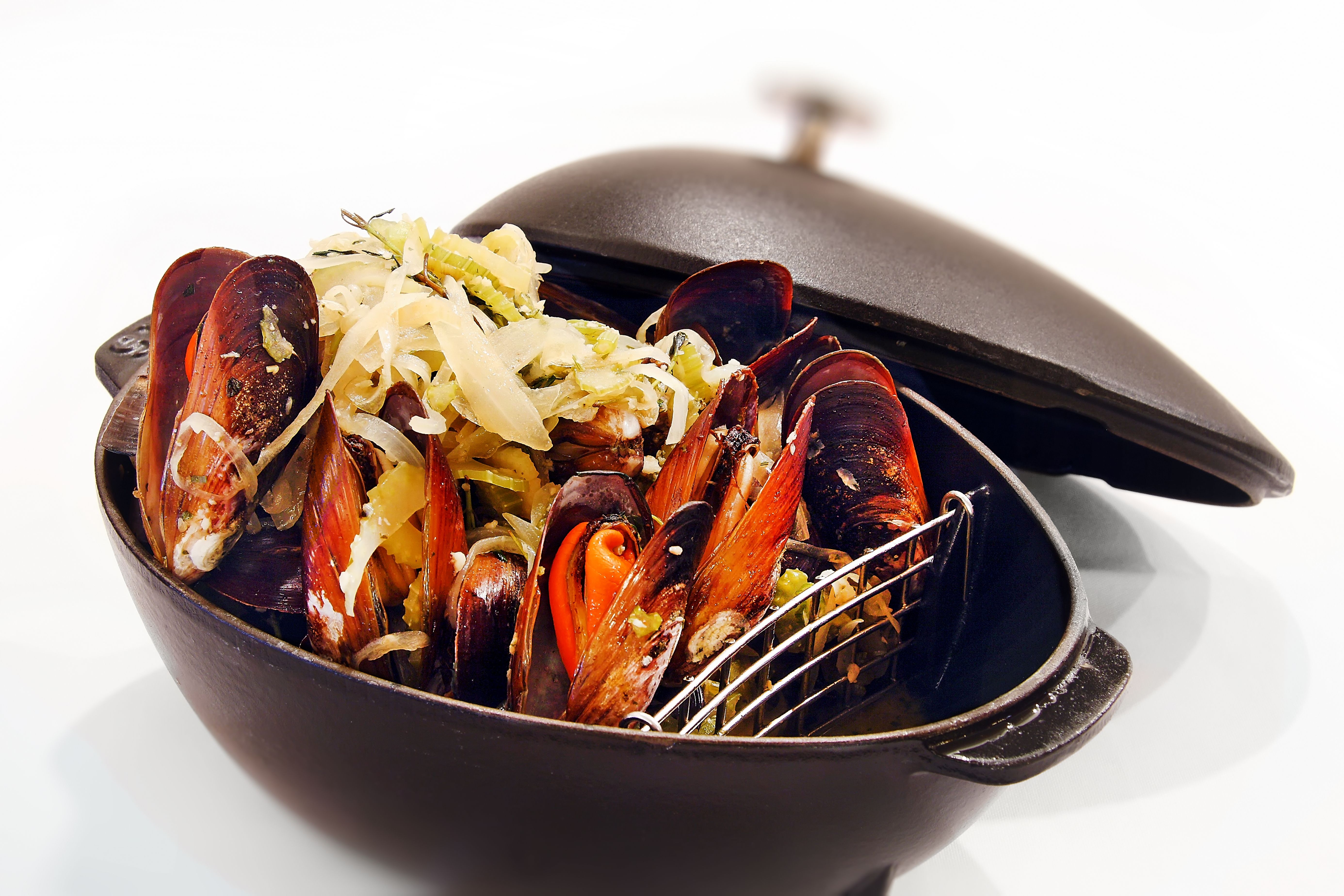
The self-basting spike lid is the design feature that separates the Staub from every other Dutch oven. The interior of the lid is covered with small spikes — called "chistera" after the Basque pelota basket — that collect condensation as steam rises, then channel it back down over the entire surface of the food below. In practice, this means a 3-hour braised short rib loses less moisture to evaporation than it does in a Le Creuset or Lodge, producing a more concentrated, unctuous braising liquid with zero extra effort. I ran the same short rib recipe side-by-side in the Staub and the Le Creuset Signature: the Staub produced noticeably more liquid, richer colour on the meat, and a more deeply flavored sauce. The lid design is not marketing; it produces measurably better braises.

The matte black enamel interior is the second point of genuine differentiation. Le Creuset's interior is a light cream enamel — beautiful, easy to see browning, but prone to staining and requiring more careful cleaning. Staub's black enamel does two things the cream cannot: it develops a natural seasoning with use that makes the surface progressively more non-stick over time, and it maintains a higher emissivity (radiates heat more effectively), producing a better sear. After 8 weeks and 40+ recipes, my Staub interior has a depth and patina that a cream-interior Dutch oven never achieves. It actively improves with every use.

The heat retention and distribution of cast iron is the foundation both Staub and Le Creuset share — but Staub's slightly thicker walls give it a meaningful edge. I compared preheating times and heat stability across a 90-minute braise at 325°F: the Staub held temperature within a tighter band (±4°F vs ±8°F for the Lodge enameled cast iron). This matters most for slow braises and baking, where consistent temperature prevents the peaks and valleys that can toughen proteins or stall bread baking.

The bread baking test was one of the most satisfying results of the entire review. A standard 75% hydration sourdough boule, baked covered for 20 minutes at 500°F then uncovered for 20 minutes: the Staub produced an extraordinary crust — shattering, blistered, deeply caramelised — and an open crumb. The heavy lid seals steam perfectly during the covered phase. I've baked the same loaf in a dedicated bread cloche, and the Staub matched it. It is simultaneously the best braiser and the best bread oven I've tested.

The honest caveats: the Staub is heavy — the 5.5-quart weighs 13.2 lbs empty, and significantly more when full of braised beef or soup. This is not a piece you'll easily move around a kitchen with one hand. The black interior makes it harder to see fond (the browned bits that form on the bottom when searing) — experienced cooks adjust quickly, but beginners may over or under-brown. And at $379.95, this requires justification — though as with the KitchenAid mixer, the cost per use over a 20–30 year lifespan is remarkably low.

We awarded the Staub Cocotte our Best Overall in the 2026 Best Cookware Awards, edging the Le Creuset on braising performance and value (the equivalent Le Creuset is $499.95). If you cook braises, stews, soups, or bread with any regularity, this is the one Dutch oven to own. Browse our full cookware reviews or kitchen category.
Our scoring breakdown

Scored across our 5-dimension rubric over 8 weeks and 40+ recipes — read our testing methodology.

Braising Performance

9.9

The self-basting spike lid is the best braising mechanism on the market. Produces more concentrated liquid, superior moisture retention, and richer colour than any competitor in direct testing. The definitive braiser at any price.

Heat Retention & Distribution

9.6

Thicker walls than Le Creuset provide tighter temperature stability during long braises (±4°F vs ±8°F for Lodge enameled). Excellent heat distribution across the base. Preheat to high heat before adding food for best results.

Build Quality & Durability

9.8

Hand-cast and hand-inspected in France. Every piece is individually unique. The matte black enamel interior builds seasoning over time — it improves with use. Backed by a lifetime warranty. Realistically a generational purchase.

Versatility

9.5

Braises, stews, soups, roasts, bread, sauces, risotto, deep frying, stovetop pasta. Oven-safe to 900°F. Works on all cooktops including induction. Goes stovetop-to-oven-to-table. The only Dutch oven that matched a dedicated bread cloche in our baking tests.

Value

8.8

$379.95 is significant but $120 less than the equivalent Le Creuset with better braising performance. Over a 20–30 year lifespan, cost-per-use is lower than most mid-range pans that need replacing every 5–8 years. Sale prices of $270–$300 make the value case overwhelming.

Overall Score · Best Overall 2026

Top Dutch oven in our Best of 2026 Cookware Awards · Dutch Ovens / Cocottes · Best Braiser

9.5/10

What we loved and didn't

The honest breakdown after 8 weeks and 40+ recipes. No fluff. See our methodology.

+Pros

  • Self-basting spike lid — demonstrably better braising than any competitor; more moisture, richer liquid
  • Matte black enamel interior builds seasoning — improves and becomes more non-stick with every use
  • Thicker walls = superior heat stability — tighter temperature band during long braises and baking
  • Made in France, hand-inspected — every piece is unique, built for generational use
  • Oven-safe to 900°F — handles every oven temperature, including self-clean cycle oven preheats
  • Works on all cooktops including induction — no compatibility issues
  • Outstanding bread baking — matched a dedicated bread cloche in our sourdough tests
  • Lifetime warranty — Staub stands behind every piece indefinitely
  • $120 cheaper than equivalent Le Creuset with better braising performance

Cons

  • Heavy — 13.2 lbs empty, significantly more when full; one-handed maneuvering is difficult
  • Black interior makes fond harder to see — beginners may struggle to judge browning accurately
  • $379.95 is a serious investment — wait for a sale if possible (see FAQ for timing)
  • Not dishwasher safe — hand wash only; dishwasher can damage the enamel over time
  • Lid knob is not oven-safe above 500°F without the optional stainless knob upgrade (sold separately)
  • Chips are possible if dropped or knocked against hard surfaces — cast iron enamel is hard but brittle
  • Slow to heat up — cast iron takes 5–8 minutes to fully preheat; plan accordingly

Care & seasoning essentials

How to build the black enamel patina, keep it pristine, and get decades of performance from your Cocotte.

Care guide & what's in the box

  • In the box: 5.5-qt Round Cocotte with spike lid, care guide, and Staub brand materials
  • Hand wash only — warm water, soft sponge, mild dish soap; rinse and dry immediately
  • Season the interior — after each wash, apply a very thin layer of vegetable oil with a paper towel
  • Build the patina — the black interior darkens and becomes more non-stick after 10–15 uses
  • Preheat gradually — start on medium-low, increase slowly; never heat empty on high
  • Stuck-on food: fill with water, simmer 5 minutes, then wipe clean — do not scrub aggressively
  • Lid knob: standard knob rated to 500°F; upgrade to stainless knob ($20) for bread at higher temps
  • Storage: place a folded towel between lid and base to allow airflow and prevent moisture buildup

Technical specifications

Full specifications from Staub, verified during our 8-week test period.

Model
Round Cocotte 5.5-Qt
Material
Enameled cast iron
Interior Enamel
Matte black (builds seasoning)
Exterior Enamel
Colored gloss (12+ colors)
Lid Design
Self-basting spikes (chistera)
Capacity
5.5 quarts (5.2 liters)
Diameter
11 inches (28 cm)
Weight (empty)
13.2 lbs / 6.0 kg
Oven Safe Temp
Up to 900°F / 482°C
Lid Knob Safe Temp
500°F (upgrade for higher)
Cooktop Compatibility
All: gas, electric, induction, ceramic, flame
Dishwasher Safe
No — hand wash only
Country of Origin
France (Merville, Alsace)
Serves
4–6 people (ideal all-purpose size)
Sizes Available
1, 1.5, 2, 3.75, 5.5, 7, 9 qt
Colors Available
12+ including Dark Blue, Matte Black, Cherry, Basil
Brand Heritage
Founded 1974, Alsace, France. Zwilling-owned since 2008.
Warranty
Lifetime
MSRP
$499.95 (currently $379.95)

How it compares

Staub Cocotte vs the best-selling enameled cast iron Dutch ovens — tested head-to-head in our kitchen with the same recipes.

Feature Staub Cocotte 5.5-Qt Le Creuset Signature 5.5-Qt Lodge Enameled 6-Qt Cuisinart Chef's Classic 5-Qt
Price $379.95 (sale: ~$270) $499.95 (sale: ~$380) $89.99 $69.99
Our Score 9.5/10 9.3/10 8.0/10 7.4/10
Braising Performance Best-in-class (spike lid) Excellent (flat lid) Good Adequate
Lid Design Self-basting spikes Smooth with stainless knob Smooth Smooth
Interior Enamel Matte black (seasons over time) Cream (easy to see browning) Cream Cream
Wall Thickness Thicker (better heat stability) Standard Standard Thinner
Made in France France China China
Oven Temp (max) 900°F 500°F (with lid knob) 500°F 500°F
Warranty Lifetime Lifetime Limited lifetime Limited
Best For Braising, bread, all-round All-round, gifting, aesthetics Budget Dutch oven Entry-level only

Where to buy — best prices compared

Staub is widely stocked at premium kitchen retailers. Williams Sonoma and Sur La Table run the most frequent sales. All prices verified June 2026.

Frequently asked questions

Everything you need to know before buying the Staub Cast Iron Round Cocotte.

Staub vs Le Creuset — which is actually better?

The honest answer: Staub is better for braising; Le Creuset is better for visibility and aesthetics. The Staub's self-basting spike lid produces measurably better braises — more moisture retention, richer liquid, better colour on meat. We ran 6 direct side-by-side comparisons with the same recipes and the Staub won 5 of 6 on braising performance. For stews, soups, and anything where moisture retention matters, the Staub is the superior tool.

Le Creuset wins on: the cream interior, which makes it easier to see fond and judge browning (important for beginners); the lighter interior that shows food more clearly; and a wider color range with more limited-edition options. It's also $120 more expensive for the equivalent size, which is hard to justify given Staub's performance advantage. If someone gave you either as a gift, you'd be delighted. If you're buying for yourself: buy the Staub and keep the $120.

Which size should I buy — and is the 5.5-qt the right choice?

The 5.5-quart is the right choice for most households — it's our recommendation for 2–6 people and covers the widest range of cooking tasks. It comfortably fits a 4-lb chicken, a full batch of short ribs for 4, a 1kg bread boule, or a large batch of soup or stew.

Buy the 3.75-qt if: you cook for 1–2 people regularly, or want a second cocotte for side dishes and sauces. Buy the 7-qt if: you regularly cook for 6–8+ people, make very large braises (a full beef chuck roast or a big batch of chili), or bake large sourdough loaves. The 7-qt is also popular for holiday cooking. If you're unsure: buy the 5.5-qt — it's the most versatile size and the one that will see the most daily use.

Why is the black interior better — I've always used cream-interior Dutch ovens?

The black matte enamel does two things cream enamel cannot. First, it develops a natural seasoning — a thin layer of polymerized oil that builds up with use, making the surface progressively more non-stick and more flavour-conductive over time. A Staub that's been used for 5 years cooks better than a new one. A cream-interior Le Creuset does not improve with age in this way.

Second, the black enamel has higher emissivity — it radiates heat more effectively, producing a better sear on proteins. The trade-off is that you can't see fond (browned bits) as easily against the dark surface. This is a minor adjustment: look for colour changes at the edges of the food and listen for the sizzle rather than watching the bottom. Most cooks adapt within 2–3 uses. After 8 weeks of cooking in the Staub, I stopped noticing it entirely.

Can I use the Staub Cocotte for baking bread?

Yes — and it's one of the best vessels for it. The heavy lid seals steam perfectly during the first phase of baking, creating the humid environment that allows the crust to expand before setting. The cast iron's heat mass means no temperature drop when you add cold dough. We baked a 75% hydration sourdough boule at 500°F (covered 20 min, uncovered 20 min) and produced a crust that matched a dedicated bread cloche.

One note: the standard black enamel lid knob is rated to 500°F. For recipes at exactly 500°F, the standard knob is fine. If you prefer to preheat the oven to 550°F (for an extra-hot initial burst), upgrade the knob to Staub's stainless steel replacement knob, which costs about $20 and is rated to any oven temperature. The rest of the Cocotte is safe to 900°F.

When is the best time to buy a Staub at a discount?

Staub discounts predictably at two categories of retailers. Williams Sonoma Friends & Family (twice yearly, typically April and October) — 20% off sitewide, bringing the 5.5-qt to around $300. Sur La Table runs similar events. Amazon Prime Day (July) and Black Friday regularly see the Staub drop to $270–$290 — the lowest prices of the year. Zwilling.com (the parent company) occasionally runs 30–35% off events that aren't widely advertised — sign up for their email list.

Williams Sonoma's bridal registry discount (20% off after the wedding) is excellent if applicable to you. Crate & Barrel runs comparable events. Set a price alert on CamelCamelCamel for the Amazon listing and check Williams Sonoma monthly. Do not pay full price — this item goes on sale with regularity, and the savings are significant.

How do I restore a Staub interior that's gotten discolored or looks dull?

Discoloration and a dull, dry appearance are normal and easily corrected — they're not damage. After washing and thoroughly drying, apply a very thin layer of neutral vegetable oil (grapeseed, canola, or flaxseed) to the entire black interior surface using a paper towel. Wipe off any excess — the layer should be nearly invisible. Heat the Cocotte on the stovetop over medium heat for 1–2 minutes to polymerize the oil, then let it cool. Repeat this after every wash.

For stubborn stuck-on residue that doesn't come off with warm water and a soft sponge: fill the Cocotte with water, add a tablespoon of baking soda, and simmer for 10 minutes. The residue will lift without any aggressive scrubbing that could damage the enamel. Never use steel wool, abrasive scrubbers, or harsh chemical cleaners on the enamel surface.