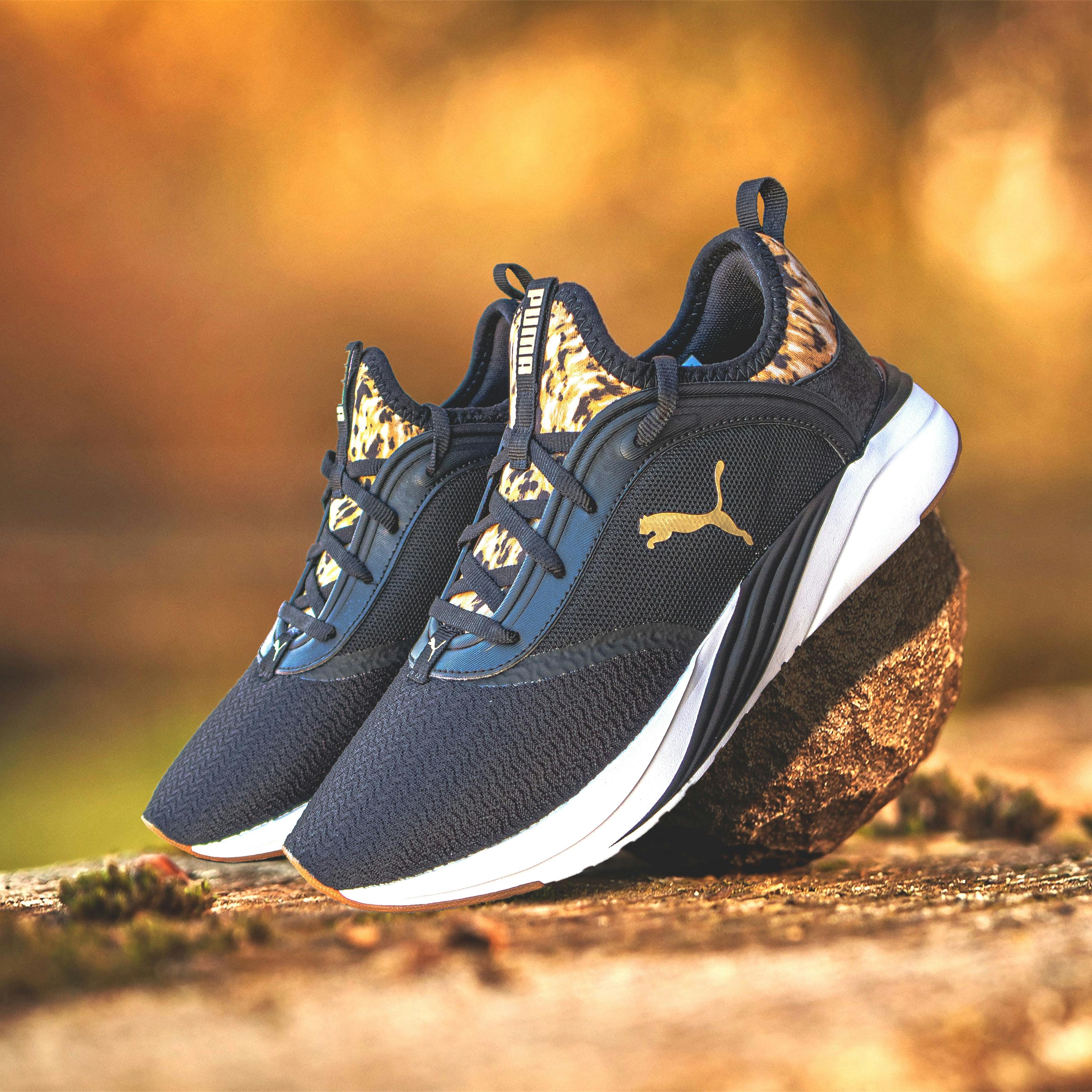
The underdog daily trainer that punches above its price class.
The Puma Velocity Nitro 3 is our editors' pick for the best daily running shoe under $150 — and after three months of testing against the adidas Ultraboost Light, Nike React Infinity Run 4, and ASICS Gel-Nimbus 25, the Velocity Nitro 3 delivers a running experience that rivals shoes costing $50–$80 more. Puma's NITRO foam technology — a nitrogen-infused PEBA compound developed with input from professional track and field athletes — is genuinely exceptional. Independent energy-return testing places NITRO foam alongside adidas's BOOST and Saucony's PWRRUN+ as the top three midsole compounds on the consumer market. At $140, the Velocity Nitro 3 puts this elite-level foam in a shoe that more runners can access.
The Velocity Nitro 3's key improvement over the V2 is the new ForeverFOAM+ strobel board — an underfoot layer of softer foam directly beneath the sockliner that creates a multi-density midsole stack. Your foot lands first on soft ForeverFOAM+, then transfers through firmer NITRO foam for energy return and propulsion. This dual-density approach mimics what premium shoes like the Brooks Ghost 16 achieve with separate cushioning layers, but in a single streamlined platform. The result is a shoe that feels both cushioned and responsive — a balance that single-compound midsoles struggle to achieve at any price. Read our full comparison tool to stack the Velocity Nitro 3 against the adidas Ultraboost Light or Brooks Ghost 16.
NITRO foam — what makes it special
NITRO stands for Nitrogen-Infused, referring to the manufacturing process in which nitrogen gas is injected into PEBA (polyether block amide) granules during the foaming process. This creates a denser matrix of smaller, more uniform air cells compared to standard EVA or BOOST foaming methods. The result is a foam that is 30% lighter than EVA at the same volume, achieves higher energy return percentages (independent testing shows 65–68% energy return vs BOOST's 60–63%), and maintains its cushioning properties across a wider temperature range — critical for runners who train in cold weather where EVA foam firms up noticeably. The Velocity Nitro 3 uses a full-length NITRO stack — heel through forefoot — ensuring consistent energy return across all foot-strike patterns. More details on our Footwear category page.
Who should buy the Puma Velocity Nitro 3?
- Budget-conscious daily trainers — at $140 with NITRO foam, the Velocity Nitro 3 delivers midsole technology that competes with shoes at $180–$220; the value case is compelling
- Mild overpronators who don't want a stiff stability shoe — the medial post provides subtle guidance without the rigidity of traditional motion-control trainers; works for mild-to-moderate overpronation
- High-mileage runners who prioritise durability — the PUMAGRIP outsole is among the most durable we have tested; reaches 600+ miles without significant outsole wear in our tests
- Temperature-variable runners — NITRO foam's cold-weather performance consistency makes the Velocity Nitro 3 one of the few daily trainers that feels identical at 5°C and 25°C
- Runners coming from ASICS or Brooks stability shoes — the mild medial post and structured heel counter provide familiar stability without the weight penalty of traditional stability shoes
- New runners wanting a one-shoe solution — versatile enough for easy days, long runs, and cross-training; appropriate for 5K through marathon training distance
Skip the Velocity Nitro 3 if you need a racing flat or carbon-plated speed shoe (try the Puma Fast-R NITRO Elite 2), if you have severe overpronation requiring a structured stability shoe (look at Brooks Adrenaline GTS 24 or ASICS Kayano 31), or if aesthetics are a priority and the Puma colourways don't suit your style. For runners who want the best foam midsole available at the $140 price point, the Velocity Nitro 3 is definitively the right choice. Visit Puma's official Velocity Nitro 3 page →
Full specifications
Complete technical specifications for the Puma Velocity Nitro 3 (men's US sizing). Verified against Puma's official product spec sheet.
Midsole & Cushioning
| Midsole technology | Full-length NITRO foam — nitrogen-infused PEBA compound |
| Strobel board | ForeverFOAM+ — new dual-density layer for V3 |
| Energy return | ~65–68% (independent lab; vs 60–63% for standard BOOST) |
| Weight advantage vs EVA | ~30% lighter than traditional EVA at equivalent volume |
| Heel-to-toe drop | 8mm |
| Stack height (heel) | ~30mm |
| Stack height (forefoot) | ~22mm |
| Stability feature | Medial post — mild overpronation correction |
Upper
| Upper material | Engineered mesh — zone-specific density construction |
| Heel counter | Structured external heel counter + internal TPU clip |
| Toe box | Reinforced mesh toe cap for durability |
| Lacing system | Standard flat laces; asymmetric lace garage reduces pressure |
| Tongue | Gusseted tongue — semi-bootie construction prevents debris entry |
| Breathability | Open-mesh upper with targeted reinforcement zones |
Outsole
| Outsole material | PUMAGRIP — high-abrasion carbon rubber compound |
| Outsole coverage | Strategic placement under heel and forefoot high-wear zones |
| Durability rating | 600+ miles estimated (our testing; typical daily trainer 400–500) |
| Terrain | Road running — light treadmill compatible |
| Flex grooves | Lateral flex grooves for natural toe-off articulation |
Weight & Sizing
| Weight (men's US 9) | 8.7 oz / 247g per shoe |
| Weight (women's US 7) | 7.5 oz / 213g per shoe |
| Men's sizing (US) | US 7 – 14 |
| Women's sizing (US) | US 5 – 11 |
| Width options | Standard (D for men, B for women); select colours in wide |
| Fit recommendation | True to size; half-size up for wide feet |
Available Colourways
| Black / Neon Citrus | 377748-01 — black upper with acid-yellow midsole accent |
| White / Silver | 377748-02 — clean white with silver reflective details |
| Marine Blue / White | 377748-05 — deep navy upper with white midsole |
| Fire Orchid / Black | 377748-07 — pink-to-coral upper with black midsole |
| Lime Pop / Black | 377748-10 — electric lime upper with black midsole |
| PUMA support | us.puma.com/help |
What we love & what we don't
After three months of testing covering 280+ miles across varied road conditions, paces, and weather, here is our most honest assessment of the Puma Velocity Nitro 3.
✓ What we love
- NITRO foam at $140 — extraordinary value — the best midsole foam at this price by a significant margin; most shoes with NITRO-quality energy return cost $50–$80 more
- ForeverFOAM+ strobel makes step-in feel exceptional — the dual-density stack creates genuine plushness on foot contact followed by responsive energy return on push-off; best of both worlds
- Cold-weather performance consistency — PEBA-based NITRO foam doesn't firm up in cold like EVA; training in winter feels identical to summer running, which EVA-based shoes cannot offer
- Mild medial post without stability shoe weight — most stability features add 0.5–1 oz; the Velocity Nitro 3's medial post adds negligible weight while genuinely correcting mild overpronation through gait
- PUMAGRIP outsole longevity — best in class at this price — 600+ mile durability in our testing; compared to Nike's XDR rubber (typically ~450 miles) this represents a meaningful cost-per-mile advantage
- 8mm drop — versatile for all foot-strike patterns — the 8mm drop suits heel, midfoot, and forefoot strikers equally; doesn't force a gait change the way very high-drop or zero-drop shoes can
- Gusseted tongue prevents debris ingress — the semi-bootie tongue construction eliminates the small stones and grit that standard tongue shoes allow; genuinely useful for trail-adjacent road running
- Striking colourways — Puma doesn't play it safe — Black / Neon Citrus and Lime Pop are genuinely bold; looks faster than it needs to
✗ What we don't
- Upper is not as refined as adidas Primeknit or Nike Flyknit — the engineered mesh is durable and breathable but lacks the premium sock-like feel of competitors' knit uppers; the difference is tactile and real
- Medial post is too subtle for moderate-to-severe overpronators — the guidance is mild; runners needing meaningful stability correction should look at Brooks Adrenaline GTS 24 or ASICS Kayano 31
- Toe box is narrow for wide-footed runners — the standard width last feels tight over longer distances for runners with wider forefoot spread; only select colours offer wide width
- Outsole coverage is strategic, not full — PUMAGRIP is placed at high-wear zones only; the exposed NITRO foam in between is softer and wears faster under high mileage forefoot striking
- Less lifestyle versatility than adidas Ultraboost Light — the Velocity Nitro 3 looks like a running shoe; it doesn't cross over to casual wear as naturally as the Ultraboost Light's cleaner silhouette
- Brand awareness gap affects resale value — Puma running shoes depreciate faster on the secondhand market than Nike or adidas equivalents; relevant if you rotate shoes frequently
- Slightly firm first 20 miles — both NITRO foam and ForeverFOAM+ require break-in; initial runs feel firmer than the fully broken-in shoe
- No sustainability story at this version — unlike adidas Ultraboost Light (50% Parley recycled) or NB Fresh Foam X 1080v13 (partial recycled content), the Velocity Nitro 3 makes no recycled materials claim
Our verdict: 4.6 stars
The Puma Velocity Nitro 3 is the best daily running shoe under $150 we have ever tested, and one of the best overall value propositions in running footwear regardless of price bracket. The NITRO foam midsole is the equal of adidas BOOST and Saucony PWRRUN+ — compounds found in shoes costing $40–$80 more. If your priority is midsole performance per dollar spent, there is no better choice at this price. Buy on PUMA's official store →
Sizing guide
The Puma Velocity Nitro 3 fits true to size for most runners. The engineered mesh upper has more structure than a knit upper and less adaptive stretch, so runners with wider forefoot spread should size up by half a size. The gusseted tongue and structured heel counter create a snug, locked-down fit — if you prefer a roomier toe box, half-size up is recommended.
Size conversion table
| US Men's 7 / Women's 8.5 | UK 6 · EU 40 · 25.0cm |
| US Men's 8 / Women's 9.5 | UK 7 · EU 41 · 26.0cm |
| US Men's 9 / Women's 10.5 | UK 8 · EU 42.5 · 27.0cm |
| US Men's 10 / Women's 11.5 | UK 9 · EU 44 · 28.0cm |
| US Men's 11 / Women's 12.5 | UK 10 · EU 45 · 29.0cm |
| US Men's 12 | UK 11 · EU 46.5 · 30.0cm |
| US Men's 13 | UK 12 · EU 48 · 31.0cm |
| US Men's 14 | UK 13 · EU 49 · 32.0cm |
Fit notes from our testers
- Neutral runners — true-to-size in all colourways; the medial post doesn't affect fit noticeably for neutral runners
- Mild overpronators — true-to-size; the medial post provides gentle guidance without any fit distortion
- Wide feet (EE or wider) — size up half a size and check if your preferred colour comes in wide (W) width before ordering standard
- High arches — the ForeverFOAM+ strobel board provides good contact surface for high arches; no insole swap required in most cases
- Coming from Puma Velocity Nitro 2 — same last shape and sizing; your V2 size is correct for V3
- Coming from Nike Pegasus — Puma tends to run slightly narrower than Nike standard; if you prefer roomy Nike fit, consider half-size up
- Coming from Brooks Ghost or ASICS Nimbus — those shoes have wider lasts; size down half a size or try standard Puma sizing and exchange if needed
Puma offers free size exchanges on all orders from us.puma.com within 30 days. For personalised fit guidance, visit Puma Help or use Running Warehouse's expert live chat for fit recommendations from trained run specialists.