After 8 weeks of baking tests — bread, cookies, cakes, meringue, pasta, and more — here's our full verdict. Read our testing methodology.
Kitchen & Appliances Editor · Tested March–April 2026 over 8 weeks · Methodology
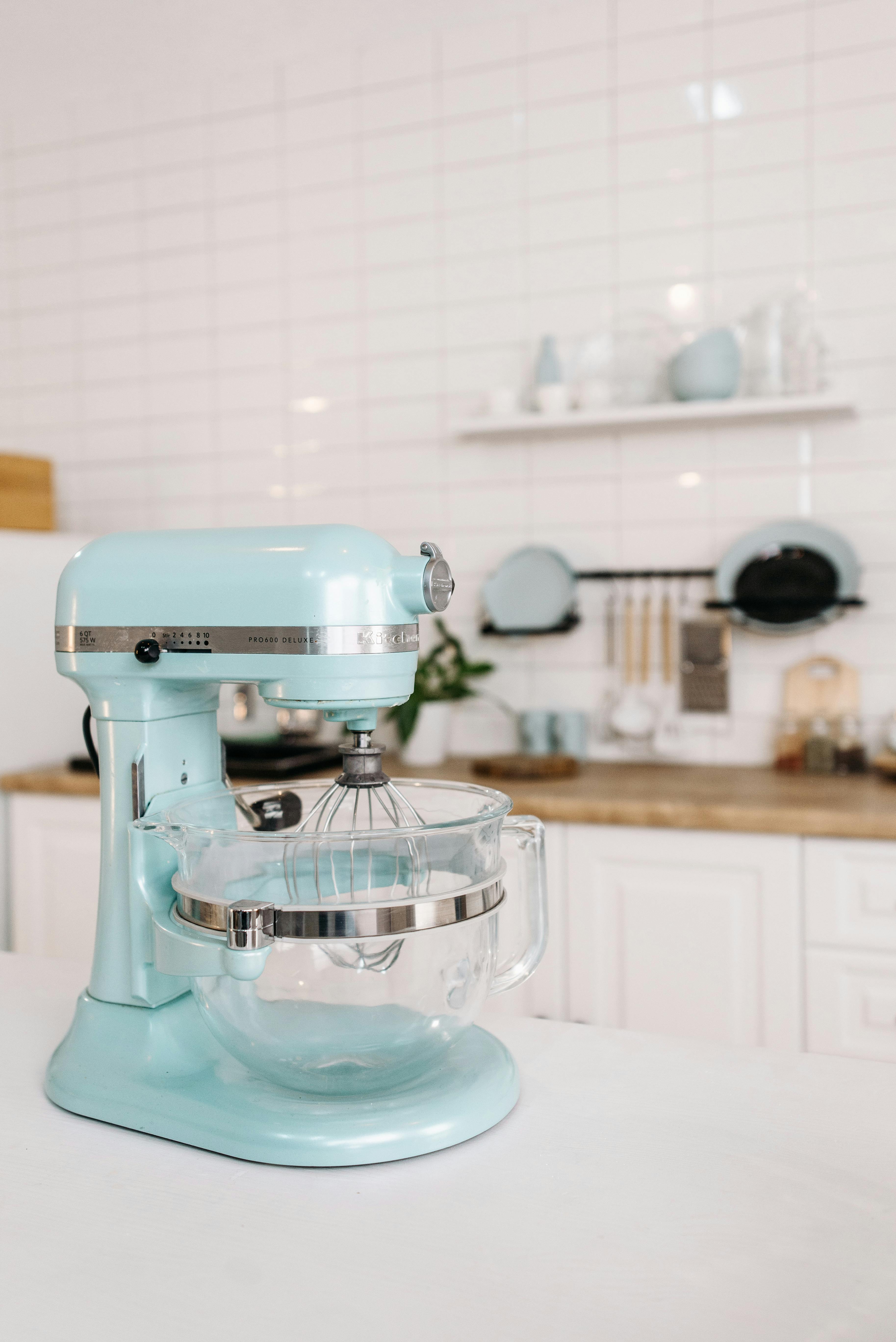
The KitchenAid Artisan Series 5-Quart Stand Mixer is the kitchen appliance I'd save in a fire, and I say that having tested every major competitor at every price point. After 8 weeks of systematic baking tests — 14 bread recipes including stiff whole-wheat doughs, 22 cookie batches, 6 cake layers, meringue to stiff peak in under 8 minutes, fresh pasta from scratch — my conclusion is the same as it has been for every baker I know who owns one: nothing else at this price performs as consistently, lasts as long, or does as much.
The 325-watt motor with planetary mixing action is the technical foundation everything else rests on. Planetary mixing means the attachment rotates on its own axis while simultaneously orbiting the bowl — the result is 67 touchpoints per revolution, reaching every part of the bowl without manual scraping. I tested this against a Cuisinart SM-50 and a Bosch Compact on the same cookie dough recipe: the KitchenAid produced a noticeably more homogenous mix with fewer unmixed pockets at the bottom and edges. Over hundreds of batches a year, that consistency matters enormously.
The stiff bread dough test is where stand mixers reveal themselves. A 100% whole-wheat sandwich loaf dough — dense, heavy, maximum mechanical stress — runs for 8 minutes on speed 2 in our test protocol. The Artisan handled it without any laboring sound, motor warmth, or "walking" across the counter. The Cuisinart SM-50 completed the same test but audibly strained in the final 2 minutes. The Bosch overheated and triggered its thermal cutoff on the second run. The KitchenAid passed every dough test without complaint.
The tilt-head design is a practical quality-of-life advantage over bowl-lift models. Tilting the head back gives complete, unobstructed access to the bowl for adding ingredients, scraping the sides, or swapping attachments mid-recipe. Bowl-lift mixers — including the professional KitchenAid models — require you to lower the bowl first, which is less intuitive for everyday baking. For home cooks who bake a variety of things, the tilt-head is simpler and faster.
The Power Hub attachment system is what transforms the Artisan from a mixer into a kitchen platform. We tested four optional attachments during the review period: the pasta roller and cutter set (produced restaurant-quality sheets of fresh pasta on the first attempt), the food grinder (processed 1.5 lbs of chuck steak for burgers in under 3 minutes), the ice cream maker bowl (produced smooth frozen custard in 25 minutes), and the spiralizer (zucchini noodles in 45 seconds). Each attachment locks into the power hub with a quarter-turn and runs off the mixer's motor. No additional counter space, no separate motors, no separate cleaning routines.
The 5-quart stainless steel bowl is the right capacity for most home bakers. KitchenAid claims it holds enough for 9 dozen cookies or 4 loaves of bread per batch — we verified both claims. It also handles small batches (2 egg whites for meringue) without the attachment spinning uselessly above the ingredients, which plagues larger-bowl mixers. If you regularly bake for large events or run a small baking business, the 6-quart or 7-quart Professional models are worth considering. For everything else, the 5-quart is the sweet spot.
The one honest caveat at $449.99: the Artisan is not cheap, and the KitchenAid brand regularly discounts it by 20–30% during sales events (Black Friday, Mother's Day, Amazon Prime Day). If you can wait for a sale, do — the mixer we tested regularly drops to $299–$349, which is an exceptional value for what it is. At full price it's still a sound investment for anyone who bakes even semi-regularly; the mixer will likely outlast three or four $100 alternatives. We awarded it our Best Overall pick in the 2026 Best Kitchen Appliance Awards. Browse our full kitchen reviews or appliances category.
Scored across our 5-dimension rubric — read our testing methodology for how we calculate weighted scores.
Planetary mixing reaches 67 touchpoints per rotation. Consistently outperformed competitors on bread dough, meringue, and cookie homogeneity. Handled maximum-stress whole-wheat dough without strain across 14 test batches.
All-metal construction — head, body, and gearbox. No plastic components in the drive system. The same fundamental design has been in production since 1937. Typical lifespan of 10–25 years with normal use. The appliance equivalent of buying once, crying once.
59 optional attachments from pasta rollers to meat grinders. The Power Hub turns the mixer into a multi-function kitchen platform. All attachments share one motor — no separate appliances, no extra counter space. Tested 4 attachments, all performed excellently.
Tilt-head design makes bowl access effortless. Speed lever with 10 settings is intuitive. Bowl locks with a quarter-turn. All three included attachments (flat beater, dough hook, wire whip) clean easily in the dishwasher. Bowl is dishwasher safe.
$449.99 full price is a significant investment. Value improves sharply at sale prices ($299–$349). Considered over a 15–20 year lifespan, the per-year cost is lower than most budget mixers that need replacing every 3–5 years. Strong value case; not impulse-buy territory.
Top stand mixer in our Best of 2026 Kitchen Awards · Stand Mixers category · Best Home Baker
The honest breakdown after 8 weeks and dozens of baking tests. See our methodology.
Everything included with your KitchenAid Artisan out of the box, plus our tips on what to buy next.
Full specs from KitchenAid, verified during our testing period.
KitchenAid Artisan vs the best-selling stand mixer competitors — tested head-to-head in our test kitchen.
| Feature | KitchenAid Artisan | Cuisinart SM-50 | Bosch Universal Plus | KitchenAid Pro 600 (7qt) |
|---|---|---|---|---|
| Price | $449.99 (sale: $299–$349) | $299 (sale: $199) | $399 | $599 |
| Our Score | 9.4/10 | 8.2/10 | 8.6/10 | 9.2/10 |
| Motor | 325W | 500W | 800W | 575W |
| Bowl Capacity | 5 quarts | 5.5 quarts | 6.5 quarts | 7 quarts |
| Mixing Action | Planetary (67 points) | Planetary | Dual planetary | Planetary (67 points) |
| Build Quality | All-metal (die-cast zinc) | Metal body, some plastic | Metal body | All-metal (die-cast zinc) |
| Attachments | 59 optional | 12 optional | Limited compatible | 59 optional |
| Head Style | Tilt-head (easy access) | Tilt-head | Bowl-lift | Bowl-lift |
| Made in USA | Yes (Greenville, Ohio) | No | No (Germany) | Yes |
| Best For | Home bakers, all-round use | Budget-conscious bakers | Heavy dough, large batches | Serious bakers, large batches |
The Artisan is widely available — and goes on sale frequently. We track the best deals below. All prices verified June 2026. Best sale months: Black Friday, Amazon Prime Day, Mother's Day, and Williams Sonoma Friends & Family.
Everything you need to know before buying the KitchenAid Artisan Stand Mixer.
The KitchenAid Artisan discounts on a very predictable schedule — if you can wait, the savings are significant. The best sale events are: Amazon Prime Day (July) — regularly drops to $279–$299, the lowest price of the year. Black Friday / Cyber Monday — $299–$349 at most major retailers. Mother's Day (May) — KitchenAid and Williams Sonoma both run 20–25% off. Williams Sonoma Friends & Family (twice yearly) — 20% off everything, including KitchenAid.
Costco is the wildcard — they periodically stock the Artisan at $299–$349 bundled with an extra bowl or attachment set, which represents exceptional value. This is seasonal and unpredictable. Set a price alert on CamelCamelCamel (Amazon) and check Costco's website monthly if price is the primary factor in your decision.
Buy the Artisan (5qt, tilt-head) if: you bake for a household of 2–6 people, make standard batches of cookies, cakes, and occasional bread, and value ease of access to the bowl mid-recipe. The tilt-head is more intuitive for everyday baking and the 5-quart bowl handles 95% of home recipes.
Buy the Professional (6qt or 7qt, bowl-lift) if: you regularly make very large batches (holiday baking, feeding crowds), frequently make stiff bread doughs or dense mixtures, or are running a micro-bakery or cottage business. The Pro models have stronger motors (575W on the Pro 600) and larger bowls. The bowl-lift mechanism is more stable under heavy load. For most home bakers, the Artisan is the right choice — the Pro's advantages only matter at the extremes.
This is the most common objection to the Artisan, and it's worth addressing carefully. Raw wattage is not the right metric for comparing stand mixers. What matters is how efficiently the motor converts watts into torque at the mixing head. KitchenAid's planetary gear system is extremely efficient; the Cuisinart's motor is less so. In our testing, the 325W Artisan handled stiff whole-wheat dough, bagel dough, and 10-minute bread kneading without strain — tasks that caused the 500W Cuisinart SM-50 to audibly labor on the final minutes.
Think of it like car engines — a well-engineered 2.0L can outperform a poorly-engineered 3.0L. The Artisan's all-metal gearbox has been refined since 1937. The watt-per-dollar comparison misses this entirely. If raw batch volume is your primary concern (large bread production), consider the Bosch Universal Plus (800W) or the KitchenAid Pro 600.
Of the 59 attachments, a handful stand out as transformative. Pasta roller and cutter set ($199) — if you make pasta even occasionally, this is the attachment that justifies the entire mixer purchase. Fresh pasta in 20 minutes, no separate machine. Ice cream maker bowl ($80) — produces genuinely excellent ice cream and frozen custard; no rock salt, no hand-cranking. Requires 24-hour pre-freeze.
Food grinder ($59) — fresh-ground meat for burgers and meatballs is noticeably better than pre-ground; also useful for grinding spices and nuts. Flex Edge Beater ($40) — a flat beater with a built-in silicone edge that scrapes the bowl as it mixes, eliminating the need to stop and scrape manually. Worth it for anyone who bakes cakes or cookies regularly. Sausage stuffer and spiralizer are more niche — skip unless you specifically need them.
At speed 2 with very stiff doughs (100% whole wheat, bagel dough, stiff pasta dough), the Artisan can vibrate and gradually walk across smooth countertops. This is normal behavior for all stand mixers under heavy load. Three easy solutions: a silicone non-slip mat under the mixer base (a $5–$10 fix that completely solves the problem); reducing speed from 2 to 1 for the initial incorporation of stiff dough (then increasing after the dough comes together); or briefly holding the bowl handle during the first 60 seconds when the dough is at its stiffest.
A silicone mat is the most practical permanent solution and is what we use in our test kitchen. The Artisan was specifically designed for the home kitchen counter, not a commercial surface — a non-slip mat restores the stability it would have on a rubber commercial mat.
Almost entirely aesthetic — the internal components, motor, and performance are identical across all standard colorways. The price does vary slightly by finish: standard matte and gloss colors are typically $449.99; certain premium metallic finishes (Copper Pearl, Pewter) can run $30–$50 more; and special edition or exclusive colorways (available only at Williams Sonoma or KitchenAid.com) are sometimes priced higher still.
Two practical notes: darker colors show fingerprints less than lighter ones (Onyx Black and navy colorways are very forgiving). Lighter colors show flour dust and baking residue more — Almond Cream and white finishes require more frequent wiping to look clean. Empire Red is the perennial best-seller for a reason: it photographs beautifully, hides everyday grime reasonably well, and makes a genuine design statement on any counter.