After 6 weeks running with the Forerunner 265 through workouts, a half marathon, and daily recovery tracking — here's our full verdict. Read our testing methodology.
Fitness Tech & Wearables Editor · Tested May–June 2026 over 6 weeks · Methodology
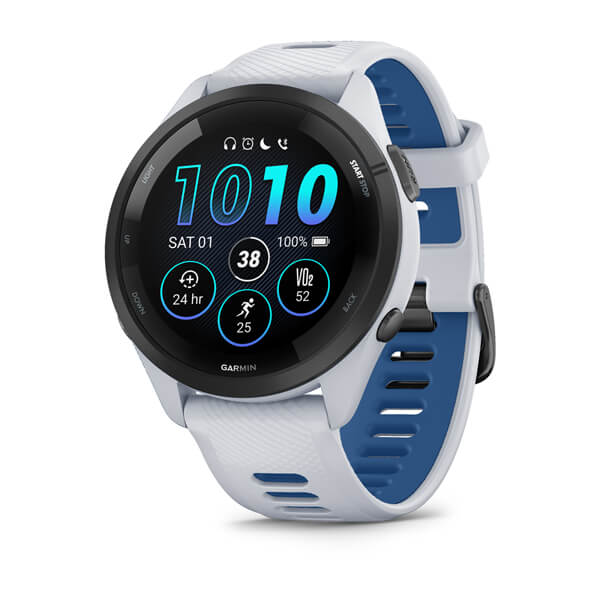
The Garmin Forerunner 265 has become one of the most recommended mid-range running watches since its March 2023 launch, and after six weeks of daily wear across training runs, a half marathon, and full recovery tracking, it's clear why it has held that position. The headline change from the Forerunner 255 is the screen — Garmin's first AMOLED touchscreen display in the 2xx Forerunner series — and the jump in everyday usability that comes with it is the most distinctive thing about this watch.
The display is bright, sharp, and genuinely pleasant to glance at mid-run, even in direct sunlight. At 1.3 inches and 416×416 resolution, data fields look crisp rather than pixelated, and the touchscreen — layered over the familiar five-button control scheme — makes scrolling through widgets and menus noticeably faster than on prior memory-in-pixel Forerunners. Several testers who came from the Forerunner 255 specifically called out how much nicer day-to-day notification glancing feels with AMOLED.
On the training side, the 265 inherits Garmin's full mid-range analytics suite: Training Readiness, Training Status, Acute Load, HRV Status, VO2 Max, and the Race Widget, which delivers personalized daily suggested workouts and race-day completion time predictions. PacePro grade-adjusted pacing guidance was a standout during hill workouts, and the Morning Report gave a quick, useful snapshot of sleep, recovery, and training outlook before each session.
The GPS performance impressed throughout testing — multi-band GNSS with SatIQ technology held a clean, accurate track through downtown routes with tall buildings and dense tree cover alike, without noticeably draining the battery faster than expected. Battery life held up close to Garmin's claimed 13 days in smartwatch mode, and a half marathon plus several easy runs barely dented the charge.
On everyday usability, the 265 performed well across very different settings — capable enough for serious marathon training, simple enough for casual daily wear, and discreet enough at 47g to forget you're wearing it. Garmin Pay and 8 GB of onboard music storage rounded out the experience nicely for runs without a phone.
The honest caveat at $449.99: the Forerunner 265 doesn't include onboard maps — that's reserved for the pricier Forerunner 965 — and a small number of testers found themselves wanting full-color route navigation on longer trail runs. The new font and loading screen also took some getting used to. That said, for the combination of a genuinely excellent AMOLED display, Garmin's full training analytics suite, and strong battery life at a mid-range price, the 265 remains one of the strongest all-around running watch picks available. We awarded it Best Mid-Range Running Watch in the 2026 Best Fitness Tech Awards. Browse our full electronics reviews or wearables category.
Scored across our 5-dimension rubric — read our testing methodology for how we calculate weighted scores.
The AMOLED touchscreen is bright, sharp, and a genuine usability upgrade over prior memory-in-pixel Forerunners. Consistently the most-praised feature across testers.
Multi-band GNSS with SatIQ held accurate tracks through dense urban routes and tree cover, with consistent heart rate readings from the Elevate Gen 4 sensor.
Training Readiness, PacePro, and the Race Widget delivered genuinely useful, personalized guidance throughout half marathon training.
Held close to the claimed 13 days in smartwatch mode. Strong for an AMOLED watch, though shorter than MIP-display alternatives like the Forerunner 255.
$449.99 is a fair mid-range price for Garmin's full training analytics suite, AMOLED display, and music storage in one package.
Top running smartwatch in our Best of 2026 Fitness Tech Awards · Wearables category · Best All-Around Pick
The honest breakdown after 6 weeks running with it across training, racing, and recovery. See our methodology.
Everything in your Garmin Forerunner 265 purchase, plus our tips on what to pair it with.
Full details from Garmin, verified during our testing period.
Garmin Forerunner 265 vs other Forerunner siblings and a top non-Garmin competitor — based on our testing and published reviews.
| Feature | Forerunner 265 | Forerunner 255 | Forerunner 965 | Coros Pace 3 |
|---|---|---|---|---|
| Price | $449.99 | $349.99 | $599.99 | $229.00 |
| Our Score | 8.8/10 | 8.2/10 | 9.0/10 | 8.0/10 |
| Display | 1.3" AMOLED touchscreen | 1.3" MIP, no touchscreen | 1.4" AMOLED touchscreen | 1.2" AMOLED touchscreen |
| Onboard Maps | No | No | Yes — full color topo | No |
| Battery (Smartwatch Mode) | 13 days | 14 days | 23 days | 17 days |
| Music Storage | 8 GB | 8 GB | 32 GB | No |
| Best For | Balanced display, training tools, and price | Maximum battery life on a budget | Trail runners who want onboard maps | Budget-conscious runners new to GPS watches |
The Forerunner 265 is widely available across sporting goods and electronics retailers. We track the best deals below. All prices verified June 2026. Best ways to save: Garmin's own seasonal sales, Amazon lightning deals, and REI's member dividend program.
Everything you need to know before buying the Garmin Forerunner 265.
The Forerunner 265 is rarely discounted directly on Garmin.com outside of occasional seasonal sales, but there are a few reliable ways to save: Amazon lightning deals and Prime Day/Black Friday events regularly bring it down by $50–$70 below MSRP. Walmart often carries it at a discounted price year-round — just confirm you're ordering the correct size (265 vs. 265S) and colorway.
If you're a REI Co-op member, buying through REI earns you an annual member dividend on top of any sale pricing, which adds up over time.
Both share identical hardware, features, and pricing at $449.99 — the only differences are case size and color. The Forerunner 265 has a 46mm case, 22mm straps, weighs 47g, and offers up to 13 days of smartwatch battery life. The Forerunner 265S has a smaller 42mm case, 18mm straps, weighs 39g, and actually lasts slightly longer at up to 15 days, since its smaller AMOLED panel draws less power.
If you have a smaller wrist or prefer a more compact watch, go with the 265S. If you want a larger, more legible display, the standard 265 is the better fit.
In our testing, the Forerunner 265 held up close to Garmin's claimed 13 days in smartwatch mode, with a half marathon and several easy training runs barely denting the charge. In all-systems multi-band GNSS mode, expect closer to 14–15 hours, and with music playback during GPS tracking, plan on roughly 6–7 hours. This is solidly competitive for an AMOLED running watch, though it falls short of memory-in-pixel alternatives like the Forerunner 255.
No. The Forerunner 265 does not include full-color topographic maps — that feature is reserved for the step-up Forerunner 965, which adds onboard mapping, a titanium bezel, and 32GB of storage for an extra $150. The 265 does support breadcrumb-trail navigation (a simple line showing your route), which is sufficient for most road and track runners but limited for trail navigation in unfamiliar terrain.
Yes — this is one of the Forerunner 265's genuine strengths. While the AMOLED panel does shorten battery life compared to the 255's memory-in-pixel display, it's noticeably brighter, sharper, and far more pleasant for everyday notification glancing and touchscreen navigation. Several of our testers who came from the 255 specifically called out the display upgrade as the single biggest quality-of-life improvement, and it remains genuinely visible in direct sunlight.
Buy the Forerunner 265 if: you want Garmin's full training analytics ecosystem — Training Readiness, PacePro, Race Widget — along with onboard music storage and Garmin Pay, and you're willing to pay a premium for the broader feature set and brand ecosystem.
Buy the Coros Pace 3 if: you want a lighter watch with longer battery life at nearly half the price, and you don't need onboard music storage or Garmin Pay. In our testing and scoring, the Forerunner 265 consistently outperformed the Pace 3 on training tool depth and display quality, making it the stronger pick for serious training, while the Pace 3 suits budget-conscious runners who want solid GPS tracking without the premium price tag.